Thursday, 30 March 2017

Google patent suggests phone packaging that doubles as a VR headset

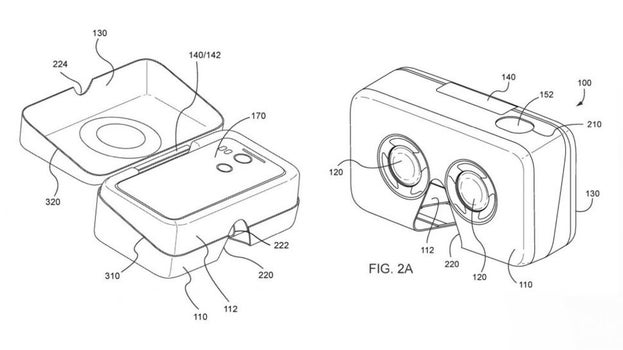
Google has already put millions of its low-end Cardboard virtual reality headsets in people's hands, and the company is clearly interested in ensuring that even more people use its VR systems. That's why it developed the mobile Daydream VR platform, which is integrated into the latest version of Android, and its own Daydream View headset. But it may want to take a more direct approach.
A patent filed last month, and just discovered by TechRadar, suggests that Google has developed mobile phone packaging that actually doubles as a VR headset. To be sure, this would be a low-end, Cardboard-like, headset. Still, if all someone had to do to try out VR was pop their brand-new phone into the very packaging it came in, it's easy to imagine quite a number of people doing just that.

6 futuristic food packaging technologies that could change everything

Food packaging could be a very different world in the near future. From "electronic tongues" that can "taste" products to bacteria-battling nano particles that are 50,000 times thinner than human hair, researchers are hard at work on some mind-blowing innovations.
The following six technologies won't just protect food from contamination or make eating easier; they stand to change the way food and beverages providers operate. So what does the future have in store? Let's have a look:

1. EDIBLE PACKAGING

In the future, you will eat your dinner and, instead of tossing the packaging in the trash or recycling bin, you will eat that, too. At least, that's what some industry experts are saying. Just within the last year, a research team at Harvard University, led by Professor David Edwards, generated multiple edible (and tasty) food containers called WikiCells. Taking inspiration from an apple, which protects its matter with edible skin, the team's inventions thus far include pumpkin soup in spinach membrane, lemon juice in a lemon membrane and melted chocolate in a cherry membrane. While Bontan Ame, an edible rice paper-wrapped candy, has been available in Japan for over a century, Edwards said he still had some stability issues to iron out, he predicted the breakthrough innovation could be available on the market within the year "in a limited way" but that, long-term, this is "the future of packaging."

2. MICRO PACKAGING
Using nanotechnology, a research team at Texas A&M University has developed what may possibly be the next food packaging miracle: micro-film. The material, which is thousands of times thinner than human hair, consists solely of water, a soluble polymer and 70% clay particles. While Jaime Grunlan, the associate professor who led the endeavor, asserts that the film is "basically dirt", the packaging is significantly more eco-friendly than plastic, has the preservation qualities of glass and could hold the fizz in a soda better than anything currently out on the market.
Meanwhile, Bayer, the chemical and pharmaceutical company, has developed a plastic film called Durethan using clay nanoparticles that prevents oxygen, moisture and carbon dioxide from decomposing food products. Similarly, Nanocor, a nanoclay technology developer, has created nano crystal-embedded plastic that prevents the escape of oxygen from beer bottles, significantly extending their shelf life up to 18 months. While companies such as Pepsico and McDonald's are still wary of any negative associations elicited by the word "nanotechnology", the food and beverage industry is looking on with rapt interest, hoping that researchers can get a handle on micro packaging and how to use it safely and effectively.

3. SMART PACKAGING
What if food packaging could tell consumers whether and when it's good or bad to eat? A team of researchers at the University of Connecticut, Rutgers University and Kraft Foods are looking into something called the "electronic tongue", an innovative technology that can effectively "taste" food through sensors embedded in the packaging. If the food is contaminated or spoiled, the packaging will change color, alerting the consumer whether it can still be cooked or needs to be thrown out. Similarly, scientists in Holland are creating smart packaging with a "release on command" insta-preservative that salvage food right before it goes bad. Even the U.S. military is looking into smart food packaging: for national security reasons, the military hopes that researchers successfully develop "super sensors" that detect whether or not food is contaminated.

4. ANTI-MICROBIAL PACKAGING
Anti-microbial packaging does not just shield food from bacteria, it actively acts against it. An Israeli graduate student named Ronen Gottesman has produced "killer paper", an anti-bacterial silver nanoparticle-coated paper that can fight to keep germs out of food. Gottesman said, "The smaller the size of the particles, the more effective they are against bacteria." Similarly, Kodak (yes, the camera company) is generating anti-microbial packaging that can absorb oxygen and keep food fresh.

5. WATER SOLUBLE PACKAGING
MonoSol, a U.S. water soluble product manufacturing company, has created Vivos edible delivery systems, which are, essentially, food pouches that dissolve in water. The plastic film packaging, which dissolves faster under hot water, supposedly cannot be tasted when eaten. MonoSol claims its product is convenient for on-the-go consumers and could be used to package such liquid-friendly fare as drink powders, cereals, soups and sauces. While MonoSol contends they are fielding interest from multinationals, the technology would need to be customized to each individual product and currently still requires secondary packaging to protect against contamination. Truly groundbreaking or commercially unfeasible? Only time will tell.

6. SELF-COOLING, SELF-HEATING PACKAGING
While consumers and industry executives have long fantasized about self-cooling and self-heating food and beverage packaging, the reality is that there is no record of commercial success... yet. Two recent innovations aim to change that. While Joseph Company International launched the Chill Can last year without too much global fanfare, the 19-years-in-the-making, EPA Stratospheric Award-winning "Microcool" technology adsorbs carbon dioxide from the atmosphere which is released when the activitation button is pressed, causing the liquid inside the can to drop to 30 degrees Fahrenheit within a matter of minutes. Similarly, HeatGenie and Crown Holdings have developed a self-heating component called HeatGenie which can heat a product to 145 degrees Fahrenheit in two minutes and is to be embedded at the bottom of a product's packaging. While the success of these particular technologies is up in the air, the convenience and marketing potential for temperature-changing packaging technology is clear.
 

Thursday, 23 March 2017

History

Ancient era

The first packages used the natural materials available at the time: baskets of reeds, wineskins (bota bags), wooden boxes, pottery vases, ceramic amphorae, wooden barrels, woven bags, etc. Processed materials were used to form packages as they were developed: for example, early glass and bronze vessels. The study of old packages is an important aspect of archaeology.
The earliest recorded use of paper for packaging dates back to 1035, when a Persian traveler visiting markets in Cairo noted that vegetables, spices and hardware were wrapped in paper for the customers after they were sold.
 

Modern era

Tinning

The use of tinplate for packaging dates back to the 18th century. The manufacture of tinplate was long a monopoly of Bohemia; in 1667 Andrew Yarranton, an English engineer, and Ambrose Crowley brought the method to England where it was improved by ironmasters including Philip Foley. By 1697, John Hanbury had a rolling mill at Pontypool for making "Pontypoole Plates".  The method pioneered there of rolling iron plates by means of cylinders enabled more uniform black plates to be produced than was possible with the former practice of hammering.
Tinplate boxes first began to be sold from ports in the Bristol Channel in 1725. The tinplate was shipped from Newport, Monmouthshire. By 1805, 80,000 boxes were made and 50,000 exported. Tobacconists in London began packaging snuff in metal-plated canisters from the 1760s onwards.

Canning


With the discovery of the importance of airtight containers for food preservation by French inventor Nicholas Appert, the tin canning process was patented by British merchant Peter Durand in 1810. After receiving the patent, Durand did not himself follow up with canning food. He sold his patent in 1812 to two other Englishmen, Bryan Donkin and John Hall, who refined the process and product and set up the world's first commercial canning factory on Southwark Park Road, London. By 1813, they were producing the first canned goods for the Royal Navy.
The progressive improvement in canning stimulated the 1855 invention of the can opener. Robert Yeates, a cutlery and surgical instrument maker of Trafalgar Place West, Hackney Road, Middlesex, UK, devised a claw-ended can opener with a hand-operated tool that haggled its way around the top of metal cans. In 1858, another lever-type opener of a more complex shape was patented in the United States by Ezra Warner of Waterbury, Connecticut.

Paper-based packaging

Set-up boxes were first used in the 16th century and modern folding cartons date back to 1839. The first corrugated box was produced commercially in 1817 in England. Corrugated (also called pleated) paper received a British patent in 1856 and was used as a liner for tall hats. Scottish-born Robert Gair invented the pre-cut paperboard box in 1890—flat pieces manufactured in bulk that folded into boxes. Gair's invention came about as a result of an accident: as a Brooklyn printer and paper-bag maker during the 1870s, he was once printing an order of seed bags, and the metal ruler, normally used to crease bags, shifted in position and cut them. Gair discovered that by cutting and creasing in one operation he could make prefabricated paperboard boxes.
Commercial paper bags were first manufactured in Bristol, England, in 1844, and the American Francis Wolle patented a machine for automated bag-making in 1852.

20th century

Packaging advancements in the early 20th century included Bakelite closures on bottles, transparent cellophane overwraps and panels on cartons. These innovations increased processing efficiency and improved food safety. As additional materials such as aluminum and several types of plastic were developed, they were incorporated into packages to improve performance and functionality.

In 1952, Michigan State University became the first university in the world to offer a degree in Packaging Engineering.
In-plant recycling has long been common for producing packaging materials. Post-consumer recycling of aluminum and paper-based products has been economical for many years: since the 1980s, post-consumer recycling has increased due to curbside recycling, consumer awareness, and regulatory pressure.

Many prominent innovations in the packaging industry were developed first for military use. Some military supplies are packaged in the same commercial packaging used for general industry. Other military packaging must transport materiel, supplies, foods, etc. under severe distribution and storage conditions. Packaging problems encountered in World War II led to Military Standard or "mil spec" regulations being applied to packaging, which was then designated "military specification packaging". As a prominent concept in the military, mil spec packaging officially came into being around 1941, due to operations in Iceland experiencing critical losses, ultimately attributed to bad packaging. In most cases, mil spec packaging solutions (such as barrier materials, field rations, antistatic bags, and various shipping crates) are similar to commercial grade packaging materials, but subject to more stringent performance and quality requirements.
As of 2003, the packaging sector accounted for about two percent of the gross national product in developed countries. About half of this market was related to food packaging.


Wednesday, 22 March 2017

image1


Home

Packaging is the technology of enclosing or protecting products for distribution, storage, sale, and use. Packaging also refers to the process of designing, evaluating, and producing packages. Packaging can be described as a coordinated system of preparing goods for transport, warehousing, logistics, sale, and end use. Packaging contains, protects, preserves, transports, informs, and sells. In many countries it is fully integrated into government, business, institutional, industrial, and personal use.

Package labeling (American English) or labeling (British English) is any written, electronic, or graphic communication on the package or on a separate but associated label.